
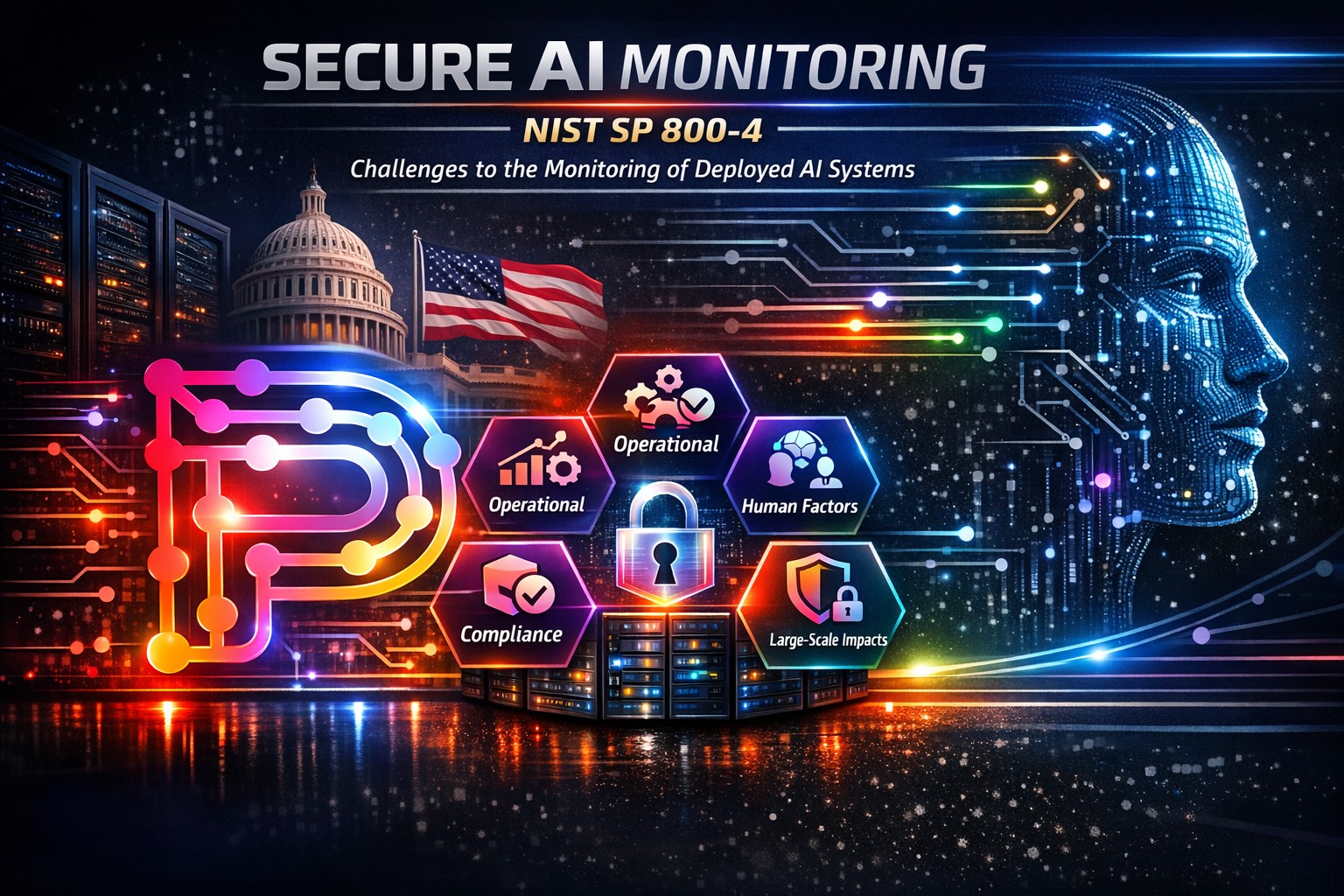
NIST AI 800-4: The Future of Post-Deployment AI Monitoring
Closing the gap between controlled testing and real-world performance with Sovereign AI Infrastructure.
In March 2026, the National Institute of Standards and Technology (NIST) released NIST AI 800-4, titled Challenges to the Monitoring of Deployed AI Systems. This technical report serves as a diagnostic tool for the AI industry, identifying a critical reality: pre-deployment testing is no longer sufficient. As AI systems move from laboratories to production environments, the risks of performance degradation, adversarial attacks, and systemic bias multiply.
For organizations relying on third-party cloud AI, NIST AI 800-4 is a wake-up call. The report highlights that effective monitoring requires a level of transparency and control that black-box cloud services simply cannot provide. To meet these standards, **Sovereign AI Infrastructure**—on-premise, locally-managed systems—is becoming the only architecturally defensible choice.
The Six Pillars of AI Monitoring
NIST AI 800-4 organizes the landscape of post-deployment oversight into six primary categories. Each requires continuous, verifiable data to ensure safety and compliance:
01 / Functionality
Ensuring the AI continues to perform its intended tasks. This includes detecting "concept drift," where the system's accuracy degrades as it encounters real-world data that differs from its training set.
02 / Operational
Monitoring infrastructure health, resource consumption, and service continuity. In a cloud environment, you are at the mercy of the provider's uptime; with sovereign infrastructure, you own the stack.
03 / Human Factors
Evaluating how users interact with the system. NIST notes that human-AI interaction is a major blind spot in current monitoring practices, requiring deeper analysis of feedback loops and output quality.
04 / Security
Protecting against adversarial attacks, prompt injections, and unauthorized access. Monitoring for security requires access to the full inference pipeline—a level of depth often hidden by cloud providers.
05 / Compliance
Adhering to laws like the EU AI Act and the White House AI Policy Framework. Compliance is now an ongoing requirement, not a one-time check-off.
06 / Large-Scale Impacts
Evaluating the systemic harms or benefits of AI at scale. This requires looking beyond individual outputs to the broader impact on organizational processes and societal outcomes.
The 5 Barriers to Effective Monitoring
Why is monitoring so difficult? NIST identifies five universal challenges:
- Lack of Trusted Tools: The absence of standardized benchmarks for real-world AI performance.
- Immature Information Sharing: Organizations rarely share data on AI incidents or performance failures.
- Rapid Pace of Innovation: Frameworks struggle to keep up with the speed of new model deployments.
- Misaligned Incentives: Competitive pressure often leads to cutting corners on rigorous monitoring.
- Resource Requirements: Continuous monitoring is computationally expensive and requires specialized talent.
The Sovereign Solution: Turning Challenges into Capabilities
Pivital Systems builds **Sovereign AI Infrastructure** specifically to address the monitoring gaps identified by NIST. When you run your AI on-premise, the "resource requirements" and "lack of tools" become engineering problems you can solve directly, rather than waiting for a cloud vendor to provide a dashboard.
Total Inference Visibility
To monitor for **Functionality** and **Security**, you need more than just API logs. You need access to the model's weights (if using open-weights models), the hardware's telemetry, and the raw inference logs. Sovereign infrastructure keeps this data within your network perimeter, allowing for high-frequency auditing without data exposure.
Operational Independence
NIST highlights **Operational** monitoring as a core requirement. Cloud AI introduces "noisy neighbor" problems and unexpected latency spikes. By deploying on dedicated hardware, your operational metrics are predictable, auditable, and entirely under your control.
Verifiable Compliance
The **Compliance** pillar of AI 800-4 requires a verifiable audit trail. Cloud providers offer "compliance as a service," but in a regulated investigation, the burden of proof is on you. Sovereign AI allows you to own your logs, your data, and your infrastructure—the only way to provide absolute proof of compliance to regulators.
Strategic Implications: Pre-Deployment is the Beginning, Not the End
The core message of NIST AI 800-4 is that AI safety is a lifecycle, not a launch event. Organizations must shift their focus from "Is it safe to deploy?" to "Is it still safe right now?"
As regulatory scrutiny intensifies, the ability to monitor, audit, and intervene in AI systems will separate the leaders from the laggards. Those who rely on external platforms will find themselves unable to answer the questions that regulators—and the NIST framework—are starting to ask.
Pivital Systems provides the infrastructure to bridge this gap. From Tier 1 local inference servers to complex custom LLM deployments, we build the foundations for AI monitoring that meets the highest federal standards.
Ready to Secure Your AI Infrastructure?
Explore our Tier 1 and Tier 2 Sovereign AI units designed for HIPAA, SEC, and NIST-compliant environments.
Explore Solutions →