
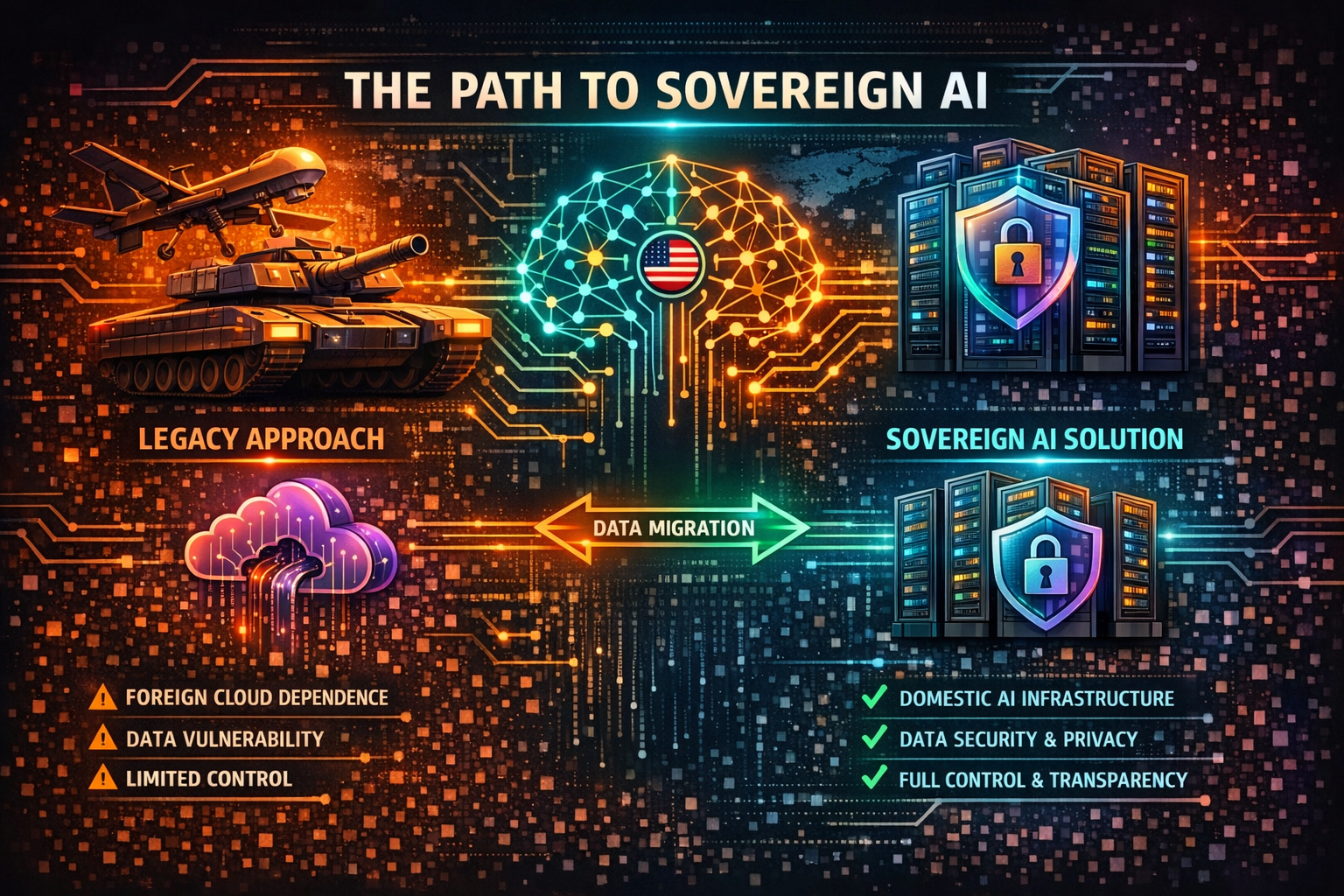
The Inference Wall Is Here. Is Your AI Stack Ready?
5 Structural Shifts from March 2026 That Expose the Real Cost of Cloud-Dependent AI
Sovereign AI Infrastructure. On-premise LLM deployment. Secure AI for Regulated Environments. The March 2026 White House AI Framework. These are no longer theoretical talking points debated in conference rooms — they are the concrete pillars of a reckoning that arrived in March 2026 and is still reverberating through every boardroom, every engineering team, and every organization that bet its future on someone else's cloud.
March was one of the most headline-dense months in AI history. Multiple frontier model releases, a federal policy framework, geopolitical disruption to global data center infrastructure, the continued collapse of SaaS valuations, and a landmark confrontation between a major AI lab and the U.S. Department of Defense. The hot takes flooded every newsletter and LinkedIn feed.
But under the noise, five structural shifts occurred that will define the next 12 months of AI strategy — and each one carries a direct implication for organizations that have not yet established sovereign control over their AI infrastructure.
01 / The Training Wall Is Behind Us. The Inference Wall Is in Front of You.
The clearest signal of March 2026 came not from a model launch, but from a shutdown. On March 24th, OpenAI quietly announced it was discontinuing Sora — its video generation product — just six months after its public launch, along with its API, its in-ChatGPT integration, and its mobile app.
The headline story was "AI video is failing." The structural story is more consequential: Sora was estimated to burn $15 million per day in inference costs against just $2.1 million in lifetime revenue. Even OpenAI's own head of Sora acknowledged publicly that the economics were fundamentally unsustainable. No go-to-market adjustment could close that gap.
This is not a story about Sora. It is a signal about the entire architecture of AI at scale. For the past three years, the AI narrative has been dominated by the training compute race — who can build the largest cluster, who can afford the most data, who can push the frontier. That race is effectively over for the vast majority of organizations. What we are hitting now is the inference wall: the brutal, ongoing cost of serving a model that already exists to real users in production.
The implications for your AI infrastructure strategy are direct. If you are running AI workloads against cloud-hosted models at inference-rate pricing, your cost structure is not under your control. You are paying for the provider's margin, their infrastructure overhead, their noisy-neighbor problem, and their model updates — whether or not those updates improve performance for your specific use case.
On-premise AI deployment with locally-hosted, optimized models eliminates this exposure. When your inference runs on hardware you control, your cost per delivered unit of value is an engineering problem you can solve — not a line item you receive from a vendor.
02 / AI Advertising Arrived — And It Converts. Your Data Is Now the Product.
On March 2nd, 2026, CRIO became the first ad-tech company to formally integrate with an OpenAI advertising pilot inside ChatGPT's free and lower-tier interfaces. Within days, CRIO was actively pitching its 17,000 advertisers on placing ads directly inside conversational AI responses.
Early data from a sample of CRIO retailers showed conversion rates from LLM-referred traffic running at 1.5 times the rate of traditional referral channels. The sample size is small, but the direction is significant.
What is actually happening here is a fundamental restructuring of the commercial internet. The traditional purchase funnel — discovery, consideration, conversion — is collapsing into a single context window. There is no page one and page two. There is a recommendation, singular, woven into a response the user already trusts.
OpenAI is not selling the ads directly. It is building the surface and letting the existing programmatic ad infrastructure operate against that surface. The model provider creates context; the ad-tech layer fills it. Your users' queries, your users' intent signals, your users' decision-making moments — these are the inventory being sold.
For organizations in regulated sectors — healthcare, legal, financial services, government contracting — this is not a theoretical privacy concern. It is a compliance exposure. When your employees use cloud-hosted AI tools, the conversational context of those interactions is traversing external infrastructure. In some configurations, it is being used for model training. In emerging advertising frameworks, it may be informing commercial targeting.
Sovereign AI Infrastructure, by definition, removes this exposure. Data that never leaves your network cannot be used as advertising inventory, cannot be used for third-party model training, and cannot be the subject of a breach disclosure you did not control.
03 / The White House Framework Preempts State Laws, But Not Physics.
On March 20th, 2026, the White House released its National Policy Framework for AI — four pages of legislative recommendations urging Congress to establish a single federal standard that preempts conflicting state AI laws. No new regulatory body. Reliance on existing sector-specific regulators. Industry-led standards. Streamlined permitting for AI infrastructure.
If you read this as "easier regulatory environment," you are reading only the first layer.
What the White House framework cannot preempt is the physical infrastructure crisis that is closing the path to AI compute in the United States. As of March 2026, lawmakers in at least 12 states have filed data center moratorium bills — formal legislative pauses on new construction while state governments study impacts on power grids and water supplies. Virginia, home to the densest data center corridor on earth, is among them. Georgia, New York, Maryland, Oklahoma, Vermont, South Dakota, Michigan, and Minnesota are all on the list.
At the local level, 54 governments have passed short-term construction freezes. At the federal level, Senator Sanders and Representative Ocasio-Cortez introduced a data center moratorium act in late March — a long shot under current congressional alignment, but a signal of the political trajectory.
The mechanism of constraint is zoning, energy regulation, and water use law — legal surfaces that federal preemption of AI regulations cannot touch. A county that will not rezone farmland for a gigawatt campus, or a state utility commission that refuses to approve a grid interconnection, will not be moved by a White House AI framework.
Meanwhile, the Gulf conflict introduced a new variable in March: Iranian drones struck AWS data center facilities in the UAE and Bahrain, damaging physical infrastructure and disrupting cloud services. The attack demonstrated for the first time that commercial hyperscale data centers can be explicit kinetic military targets. Data residency rules complicated disaster recovery: affected platforms could not migrate workloads without regulatory approval.
The cumulative picture is this: the physical geography of AI infrastructure is becoming constrained, contested, and conflict-exposed simultaneously. Organizations whose AI runs on infrastructure they do not own — in locations they do not control — are subject to every one of these constraints. Sovereign AI Infrastructure, hosted on-premise in your own facility, is the only architecture that removes this dependency entirely.
04 / SaaS Is Dying. Seat-Based Pricing Is Over. What Replaces It Is Being Built Now.
On March 11th, 2026, Atlassian CEO Mike Cannon-Brookes announced the layoff of 1,600 employees — over 900 of them in software engineering roles — with 20 minutes notice and a six-hour Slack window. The company simultaneously disclosed that its CTO would be replaced by two executives from AI-native backgrounds.
This would be a standard restructuring story if not for one detail: five months earlier, Cannon-Brookes had publicly predicted that Atlassian would employ more engineers in five years, not fewer, and pledged increased graduate hiring.
The market understood what this reversal meant. Atlassian reported its first-ever decline in enterprise seat counts. The mechanism driving that decline is straightforward: if 10 AI agents can do the work of 100 software users, you need 10 SaaS seats, not 100. That is a 90% revenue compression for the same work output. By early March, tech layoffs globally had surpassed 45,000, with AI among the most frequently cited justifications.
What is being built to replace per-seat pricing is outcome-based and workflow-based pricing — and it runs on AI agents. The organizations building competitive advantage right now are not waiting for SaaS vendors to reinvent their pricing models. They are deploying custom agentic AI systems on infrastructure they control, automating workflows at the rate that the new economics demand.
This is exactly what Pivital's Offering 04 (Agentic) is built for. Enterprise-grade agentic AI deployment on sovereign infrastructure, designed for the complex, sensitive workflows that cannot be handed to a vendor's shared model and a shared compute environment.
05 / Safety Posture Is Now a Market Position — and It Has Revenue Consequences.
In late February 2026, Anthropic's CEO published a statement explaining that the company could not accept the Pentagon's demand that its AI models be available for all lawful purposes without restriction. Anthropic's red lines: no fully autonomous weapons, no mass surveillance of American citizens.
The Pentagon said it could not accept a private company dictating terms on a classified network. Negotiations collapsed. The federal government directed agencies to cease use of Anthropic technology. The Defense Secretary designated Anthropic a supply chain risk. Defense contractors were required to certify they did not use Claude.
The cost was an estimated $200 million contract and a government-wide ban. The benefit — and this is the structural signal — was record consumer adoption, measurable goodwill among enterprise buyers who weight AI governance in their procurement criteria, and a differentiation that no marketing campaign could purchase.
Safety posture is no longer just an ethics question. It is a market positioning question with direct revenue consequences that run in multiple directions.
For organizations in regulated environments — healthcare, legal, finance, government contracting — this sorting of AI providers by safety posture is not abstract. It directly affects which tools your compliance team can approve, which vendor relationships your contracts can accommodate, and which AI infrastructure choices can survive a regulatory audit.
Sovereign AI Infrastructure resolves the alignment question at the architectural level. When you run your own models on your own hardware, you are not dependent on the safety posture of a cloud provider, the policy decisions of a model lab, or the outcome of a government contract dispute. Your AI governance is your own.
What March 2026 Means for Your AI Infrastructure Decision
Read the through-line across all five structural shifts, and a single, coherent picture emerges:
The era of "AI as a cloud service you simply subscribe to" is encountering its hard limits simultaneously — from the economics of inference, the monetization of user data, the physical constraints on compute geography, the collapse of SaaS seat economics, and the increasing scrutiny of model provider safety postures.
Every one of these pressures resolves in the same direction: toward infrastructure you own, control, and can audit.
Pivital Systems builds Sovereign AI Infrastructure for organizations that cannot afford to wait for the next wave of headlines. Our deployment tiers are designed for exactly this moment:
- 01 Standard ($650/month) — The sovereign entry point for organizations up to 10 users. Dedicated on-premise inference. Your data stays in your facility. Your audit trail is yours.
- 01 Growth ($1,250/month) — Expands to 30 users with 8 hours of monthly custom development, allowing continuous refinement of your AI systems against your actual operational requirements.
- 04 Agentic (Custom Pricing) — Enterprise-grade agentic AI deployment for complex, sensitive workflows that require the combination of sovereign infrastructure, custom model tuning, and controlled automation at scale.
The Structural Shift Is Not Coming. It Already Happened.
The five events above did not produce a lot of good TikToks. They were not the kind of announcements that generate a flood of newsletter reactions. But they will shape the competitive landscape of AI deployment for the next 12 months in ways that the model release headlines will not.
The organizations that recognize this moment and act on it — that move their AI infrastructure from cloud dependency to sovereign control — will be the ones that retain optionality as the economics, regulations, and geopolitics of AI continue to shift.
The organizations that do not will find themselves constrained by every one of the forces March 2026 just exposed.
Ready to Architect Your Sovereign AI Infrastructure?
The contact form at pivital.ai is where the engineering conversation starts. Tell us about your environment, your compliance requirements, and your current AI deployment — and we will build you a deployment plan that removes cloud dependency without removing capability.
Start an engineering conversation → pivital.ai/contact