
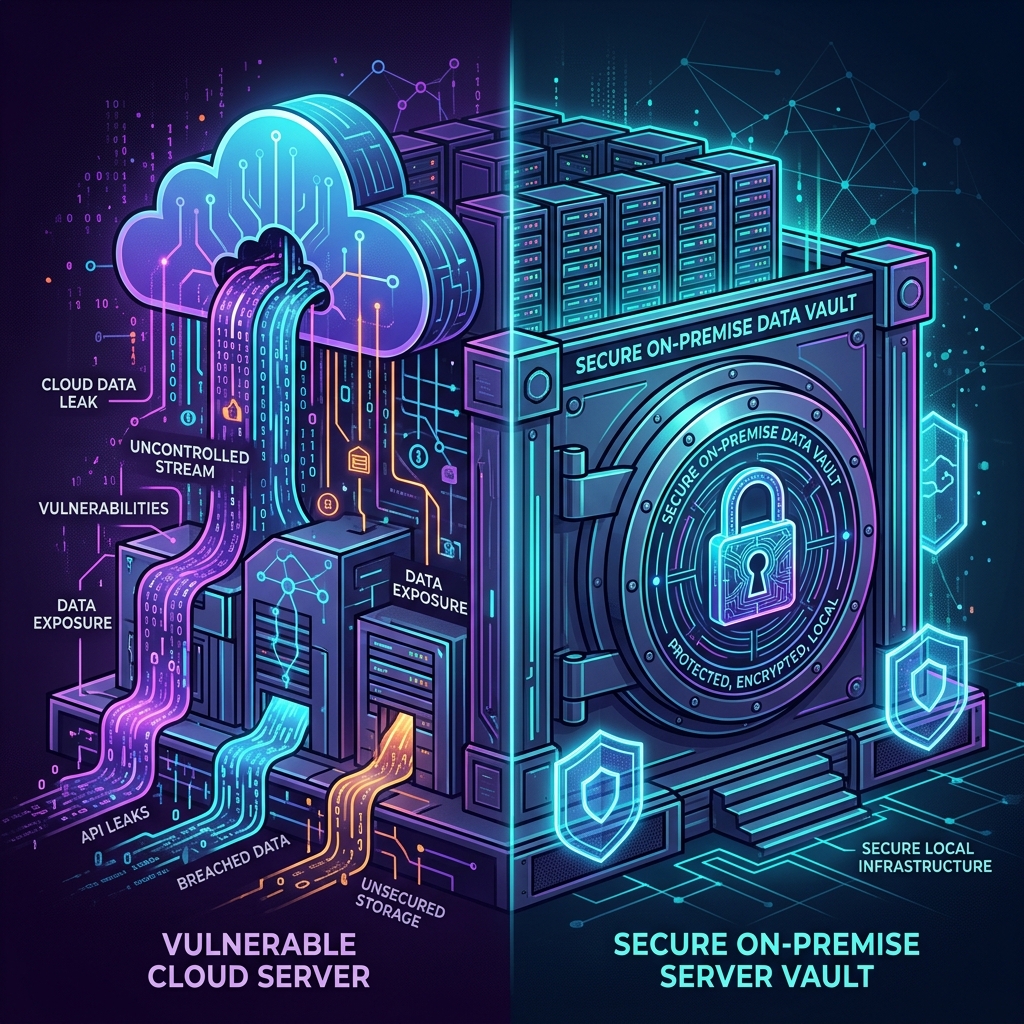
The Claude Code Leak: A Warning on Cloud AI Security Risks
Why relying on cloud-based AI tools creates systemic risks for your company's proprietary data and intellectual property.
In late March 2026, the technology sector experienced a sobering wake-up call when internal source code belonging to Anthropic's Claude Code—a powerful AI coding assistant—was inadvertently pushed to the public npm package registry. While Anthropic quickly confirmed that the leak, caused by a simple packaging error, exposed internal architecture rather than customer data, the incident casts a long shadow over the security assumptions powering today's AI gold rush.
For organizations rushing to adopt cloud-based AI tools and integrate them deep into their codebases and daily workflows, this leak is not just a headline. It is a critical reminder that when you rely on remote infrastructure for your most sensitive operations, your security perimeter effectively ends where your vendor's begins.
The Illusion of Impenetrable Cloud Security
Cloud AI providers invest millions in security, building formidable defenses against external threats. However, as the Claude Code incident demonstrates, even the most sophisticated AI labs are vulnerable to human error and supply chain slip-ups. A single misconfigured debug file, such as the source map in version 2.1.88 of Claude Code, was enough to expose 512,000 lines of proprietary code to the world.
If an organization dedicated to building the future of artificial intelligence can accidentally leak its intellectual property, is it prudent to trust that same infrastructure with yours? When you send your company's proprietary algorithms, customer records, and strategic plans to a cloud AI endpoint, you are expanding your attack surface to include your vendor's internal processes, deployment pipelines, and employee mistakes.
The IP Contamination Risk in Cloud Tooling
The leak also underscores a growing concern regarding the tools used by developers and knowledge workers. Cloud-based coding assistants and productivity AI tools are deeply integrated into local environments, but they fundamentally operate by streaming sensitive context—code snippets, internal documentation, and conversational queries—back to their host servers.
This creates two massive vulnerabilities for businesses:
1. Data Exfiltration through Telemetry and Logs
Cloud AI tools inherently log interactions for service improvement, troubleshooting, and abuse monitoring. Your company's sensitive data becomes part of a vendor's centralized repository. A breach or leak at the vendor level doesn't just expose their technology; it exposes the queries and context provided by their users.
2. The Black Box of Model Training
While many enterprise tiers promise privacy, the default behavior of many cloud AI tools is to use user inputs for future model training. This creates intellectual property contamination. Your proprietary codebase or business strategy could subtly influence the model's future outputs, essentially leaking your trade secrets back into the global ether.
The Case for Sovereign, On-Premise AI Infrastructure
The only foolproof way to ensure that your data security and ability to continue creating AI tools are not compromised by third-party failures is to eliminate the third party. Sovereign AI—running models on physical, on-premise hardware that you own and control—is rapidly shifting from a niche requirement to a standard business imperative.
Why On-Premise AI is the Long-Term Solution:
Absolute Data Sovereignty
When you run models like Llama 3 or Mistral on your own inference servers, your data never leaves your building. Your code, customer data, and internal prompt engineering cannot be leaked by a cloud vendor's packaging error because they never ping a cloud server in the first place.
Business Continuity and Control
Cloud reliance means your tools can go offline due to internet outages, API rate limits, or vendor downtime. Furthermore, vendors frequently updating or deprecating models can unexpectedly break your custom workflows. With on-premise infrastructure, you control the deployment lifecycle. Your AI capabilities remain online and consistent regardless of external factors.
Predictable Economics
The transition away from cloud AI is also driven by economics. Renting compute per-token creates unpredictable operational expenses. Investing in on-premise hardware shifts AI from an unpredictable recurring cost to a fixed capitalist asset with a defined ROI.
Securing Your Future
The Claude Code leak was a fortunate miss for customers—no user data was compromised. But it serves as a stark warning. As AI tools gain access to increasingly critical business operations, hoping that cloud vendors maintain perfect security hygiene is not a viable strategy.
Companies serious about data security, compliance, and long-term technological independence must recognize that the most secure AI is the AI running on hardware you can touch, behind firewalls you control.
Take Control of Your AI Infrastructure
Pivital Systems provides customized, secure, on-premise AI hardware solutions ensuring your proprietary data never leaves your physical control.
Explore Sovereign AI Solutions →