
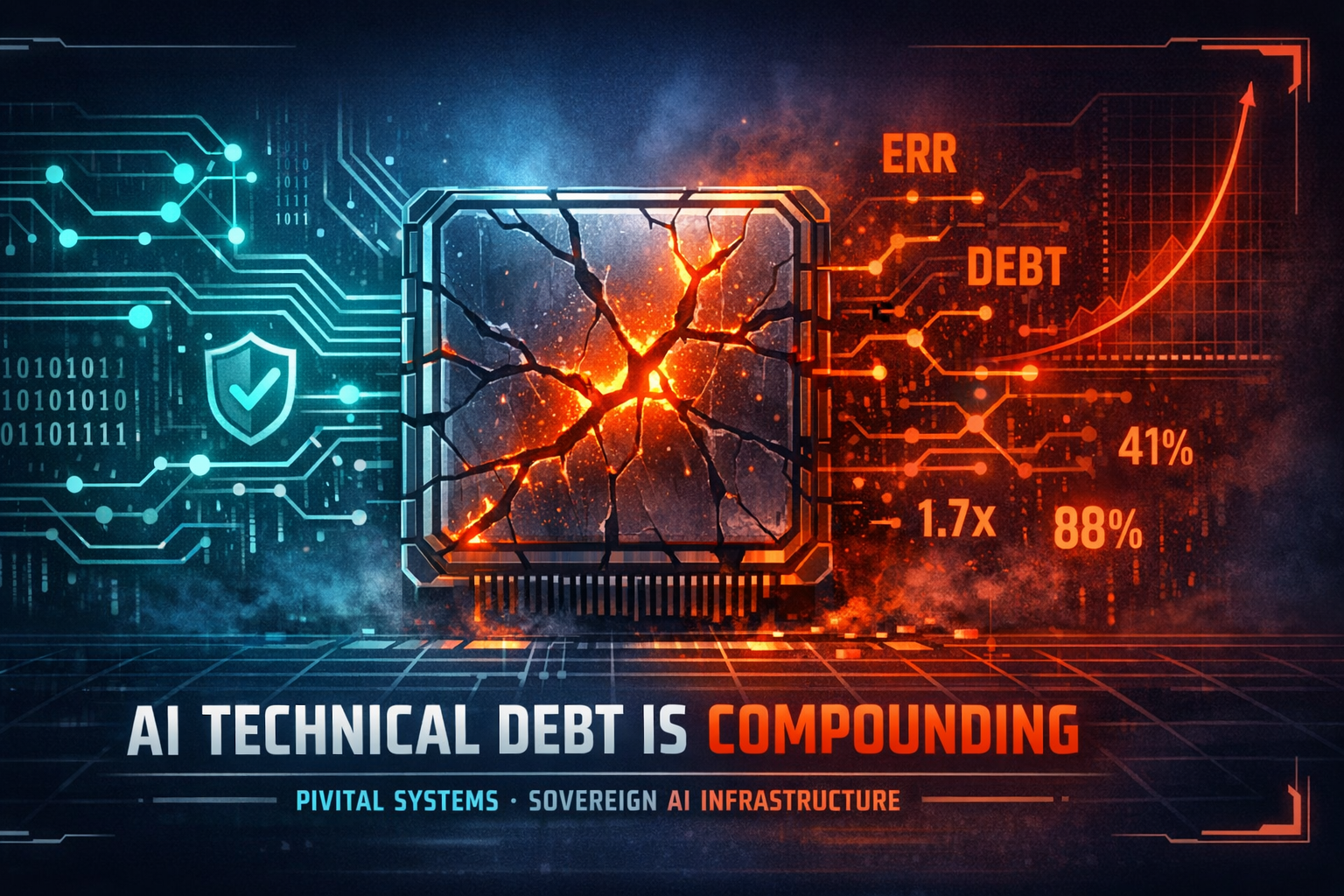
AI Technical Debt Is Compounding. Your Infrastructure Is the Only Fix.
Why on-premise sovereign AI infrastructure is the engineering discipline that prevents AI debt from becoming an organizational crisis.
Sovereign AI infrastructure, on-premise LLM deployment, and secure AI for regulated environments have never been more critical than they are right now. Under the March 2026 White House AI Framework and intensifying federal oversight, organizations are racing to deploy AI systems — chatbots, agents, automations, agentic workflows — and the demos look great. But behind the polished interfaces, a quieter crisis is building: hard-coded prompts with no evaluation framework, models with no version control, security treated as an afterthought, and governance policies that exist only in theory. This is AI technical debt, and it is compounding faster than your model accuracy is improving.
The concept is not new. In traditional software, technical debt is the future cost of present shortcuts — the interest you pay because you did not make a large enough down payment upfront. Those payments arrive as bugs, refactoring cycles, and maintenance overhead. But in AI systems, the debt dynamics are fundamentally different — and far more dangerous.
The Numbers Tell the Story
The scale of AI technical debt in 2026 is no longer theoretical. Research analyzing 8.1 million pull requests across 4,800 development teams has revealed a productivity paradox that every organization deploying AI needs to understand. AI-generated code now accounts for roughly 41% of all committed code in commercial environments. Developers report feeling 25% more productive. But when you measure end-to-end delivery — not just individual task completion — teams are actually 19% slower.
The quality gap is even more alarming. AI-generated code produces 1.7 times more issues per pull request than human-written code. Pull requests per developer are up 20%, but incidents per pull request have jumped 23.5%. Technical debt increases 30–41% after AI tool adoption. Forrester projects that 75% of technology decision-makers will face moderate to severe technical debt by the end of 2026. Gartner goes further, predicting that prompt-to-app development approaches will increase software defects by 2,500% by 2028.
For organizations running AI workloads on cloud infrastructure they do not control, these numbers are not just concerning — they represent an existential risk to system reliability, compliance posture, and operational sovereignty.
Why AI Debt Is Different from Software Debt
Traditional software is deterministic. Given a set of inputs, you expect the same outputs every time. It is predictable, testable, and when debt accumulates, it manifests as spaghetti code, hard-coded assumptions, and missing test coverage. The cost of changes is high, but the failure modes are understood.
AI systems are probabilistic. The same inputs can produce different outputs depending on context, conversation history, and the stochastic nature of the model itself. One researcher described this characteristic concisely: change anything, changes everything. This means that AI technical debt does not accumulate linearly the way traditional software debt does. It compounds. Shortcuts interact with each other, creating cascading failure modes that are harder to detect, harder to reproduce, and exponentially more expensive to remediate.
When you layer cloud dependency on top of this — running AI workloads on infrastructure you do not own, with dependency chains you did not audit, and update cycles you do not control — the compounding accelerates. The debt is not just in your code. It is in your entire operational stack.
The Four Vectors of AI Technical Debt
01 / Data Debt
There is no AI without data, and there is no reliable AI without disciplined data governance. Data debt accumulates when training sets are unvetted, when bias goes unchecked because the training distribution is skewed, when drift is not monitored over time, and when data poisoning is not defended against because nobody took the time to implement validation pipelines. In cloud environments, your data transits infrastructure you do not control. Anonymization, lineage tracking, and data provenance — the very practices that prevent data debt — are difficult to enforce when your data leaves your network perimeter.
02 / Model Debt
Model debt emerges from the absence of version control, evaluation metrics, rollback capabilities, and penetration testing. When a cloud provider updates the model behind your API endpoint — and they do, regularly — your organization inherits whatever behavioral changes that update introduced. You had no say in the update. You have no mechanism for rollback. You may not even know the update happened. This is model debt imposed on you from outside your organization, and it is the most insidious form because it is entirely invisible until something breaks in production.
03 / Prompt Debt
Prompt debt is the accumulation of undocumented system prompts, unvalidated inputs, and missing guardrails. In systems deployed without an AI gateway — a layer that inspects inputs for prompt injection attempts and redacts sensitive data from outputs — prompt debt leads directly to data leakage, unauthorized behavior modification, and compliance violations. When your prompt infrastructure runs on a third-party platform, implementing the kind of deep input/output monitoring that prevents prompt debt requires trusting that platform to inspect its own behavior. That is a structural conflict of interest.
04 / Organizational Debt
Organizational debt is the absence of governance policies, ownership assignments, red teaming practices, and capacity planning. It is the most expensive category because it multiplies every other form of debt. Without a clear governance framework, nobody knows whether the system is operating within acceptable parameters — because nobody defined what "acceptable" means. Without red teaming, the system's failure modes remain undiscovered until a customer, a regulator, or an adversary finds them first. Without capacity planning, the system that performed well in prototype collapses under production load.
The Cloud Multiplier Effect
Every category of AI technical debt is amplified when your AI workloads run on infrastructure you do not own. Cloud-based AI tools are not isolated applications. They are deeply integrated into software development pipelines, internal knowledge bases, and operational workflows. When the environment those tools run on is shared, managed by a third party, and updated continuously with dependencies your team did not vet, the attack surface for debt accumulation expands beyond your ability to audit.
IBM research found that for a $20 billion enterprise putting 20% of IT spend into AI, technical debt adds more than $120 million per year in hidden implementation costs. Organizations that proactively account for technical debt in their AI business cases project 29% higher ROI than those that do not. Ignore it, and returns drop by 18–29%, turning strong margins into marginal outcomes.
The pattern is consistent: organizations measuring AI adoption rates and feature velocity while ignoring technical debt accumulation are optimizing for the wrong metrics. Speed without discipline produces compounding interest on debt that will eventually consume the very budgets allocated for innovation.
Sovereign Infrastructure: Engineering Discipline at the Hardware Level
Pivital Systems builds Sovereign AI Infrastructure specifically to address the structural conditions that allow AI technical debt to compound. When your AI runs on hardware you control, in environments you manage, every category of debt becomes an engineering problem with a verifiable solution — not a vendor dependency with a hope and a prayer.
Controlled Data Pipelines
On-premise deployment means your training data, your inference outputs, and your evaluation metrics never leave your network perimeter. Data lineage is auditable from ingestion to output. Bias testing runs on hardware you own. Drift monitoring is continuous, local, and under your operational control. Data debt is not eliminated — it is made visible and manageable.
Pinned Model Governance
When your model runs locally, version updates happen on your schedule, not your vendor's. You control the evaluation framework. You own the rollback mechanism. Penetration testing runs against the actual model in your production environment, not a staging proxy. Model debt cannot accumulate invisibly because you have full telemetry over every component of the inference pipeline.
Deep Prompt Monitoring
Sovereign infrastructure allows you to deploy AI gateways at the network level — inspecting every input for injection attempts, validating every output against your compliance policies, and redacting sensitive information before it reaches the model or the user. Prompt debt is caught at the infrastructure layer, not discovered in a post-incident review.
Governance by Architecture
The most effective governance is not a policy document. It is an architecture that makes non-compliance structurally difficult. When your AI infrastructure is air-gapped or network-segmented, when dependency trees are audited and pinned, when capacity is provisioned on dedicated hardware with predictable performance characteristics — organizational debt is addressed at the foundation, not papered over with process.
Ready, Aim, Fire — Not Ready, Fire, Aim
The fundamentals of engineering discipline have not changed because the technology is AI. Requirements, architecture, implementation, testing, deployment, evaluation — the lifecycle still applies. AI technical debt is what results when speed outpaces discipline. The interest compounds. And the bill always comes due.
The organizations that will thrive in 2026 and beyond are not the ones generating the most code or deploying the most agents. They are the ones with the engineering discipline to deploy AI on infrastructure they control, with governance frameworks they can verify, and with technical debt they can see, measure, and systematically burn down.
Burn Down Your AI Technical Debt
Pivital Systems builds on-premise AI servers, custom LLMs, and sovereign infrastructure designed for organizations that refuse to trade speed for long-term system health. From our 01 Standard tier at $650/mo for teams up to 10 users, to our 01 Growth tier at $1,250/mo with 8 hours of monthly development, to our 04 Agentic platform for enterprise-scale automation — we build the foundation that makes AI debt visible, manageable, and preventable.
Start an Engineering Conversation →